
Modular Office Buildings in Sisaket: A Practical Guide
For businesses looking to expand or establish a footprint in Sisaket, traditional construction can often feel slow, costly, and disruptive. Modular office buildings in Sisaket have emerged as a high-efficiency alternative, offering a streamlined path to professional workspace creation. By leveraging off-site manufacturing, these structures allow companies to bypass many of the common delays associated with on-site building, making them an increasingly popular choice for developers and SME owners in the region.
modular office buildings in Sisaket: Why Choose Modular Construction in Sisaket?
The primary advantage of modular construction lies in its precision and speed. Unlike traditional methods where weather patterns and site logistics can stall progress for months, modular units are prefabricated in controlled factory environments. This means that while your site preparation is happening in Sisaket, the building components are being manufactured simultaneously. This parallel processing significantly reduces the overall project timeline.
Key Benefits for Local Businesses
- Speed to Occupancy: Reduce construction timelines by up to 50% compared to traditional builds.
- Cost Predictability: Fixed factory pricing minimizes the risk of budget overruns caused by on-site material waste or labor delays.
- Sustainability: Modular construction generates significantly less on-site waste and allows for better material recycling.
- Flexibility: These structures are designed for scalability; you can easily add more modules as your business grows.
Planning Your Modular Project
Successfully implementing modular office buildings in Sisaket requires careful planning. While the process is faster, it demands more front-end preparation. You cannot simply “wing it” once the modules arrive on-site. The foundation, utility connections, and site access must be perfectly aligned with the factory-fabricated units.
The Decision Matrix: Traditional vs. Modular
| Feature | Traditional Construction | Modular Construction |
|---|---|---|
| Construction Speed | Slow (Site-dependent) | Fast (Concurrent) |
| Cost Control | Variable (Change orders) | High (Fixed-price) |
| Design Flexibility | High (Custom) | Moderate (Standardized) |
| Site Disruption | High | Minimal |
Site Preparation and Logistics
Before the modules arrive, your site in Sisaket needs to be ready. This includes clearing, leveling, and pouring the foundation (usually concrete piers or a slab). Furthermore, because these buildings are transported via large trucks, you must verify that the access roads to your property can accommodate heavy transport vehicles. Narrow rural roads or tight urban corners can become significant bottlenecks if not assessed early in the planning phase.
Checklist for a Successful Modular Build
Use this checklist to keep your project on track:
- Site Survey: Confirm soil stability and accessibility for heavy cranes and transport trucks.
- Utility Mapping: Ensure electricity, water, and sewage connections are positioned to meet the modular design.
- Permitting: Verify local Sisaket building codes. Even though it is modular, it must comply with all standard structural and safety regulations.
- Vendor Selection: Choose a provider with experience in transporting and installing units in the Isan region.
- Contract Review: Ensure the scope includes on-site assembly, crane rental, and final utility hookups.
Common Misconceptions
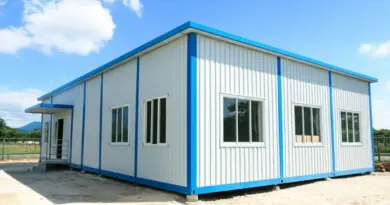
A common myth is that modular offices are “temporary” or lower quality. Modern modular buildings are constructed using the same high-quality materials—steel frames, reinforced concrete, and modern insulation—as traditional buildings. They are designed to meet or exceed building codes and are often more energy-efficient due to the tighter tolerances achieved in factory settings. When finished with appropriate cladding and interior design, they are indistinguishable from conventional offices.
Conclusion
Modular office buildings in Sisaket represent a smart, forward-thinking approach to commercial infrastructure. By prioritizing upfront planning and selecting the right partners, businesses can secure high-quality, durable workspaces that support growth while avoiding the unpredictability of traditional construction. As the region continues to develop, modular options will likely become a cornerstone of efficient business expansion.
Frequently Asked Questions (FAQ)
Yes, they are designed to be permanent structures. They are built to standard building codes and are meant for long-term use, though they have the added benefit of being relocatable if business needs change.
Once the site is prepared, the actual assembly of the modules on-site typically takes only a few days to a couple of weeks, depending on the complexity of the building.
Absolutely. While modular design relies on standardized sections, these sections can be configured in various ways to create unique floor plans and aesthetics.